Preparing young people not simply to hold certificates,
but to think, create, produce, innovate, work and build
sustainable livelihoods in a rapidly changing world.
Editorial note:
This is a contemporary adaptation of the President's long-standing
message on education, employment and skills, updated using themes
from recent public addresses. It is not presented as a verbatim
new State House speech.
H.E. Yoweri Kaguta Museveni
President of the Republic of Uganda
A changing education landscape
Education must increasingly connect learning with productive life
The education challenge today is no longer simply how many young
people enter school. It is also whether learners leave education
with useful knowledge, practical competence, values, confidence
and the ability to participate meaningfully in society and the economy.
The expansion of education through Universal Primary Education,
Universal Secondary Education, universities, vocational institutions
and other training opportunities has enabled millions of young people
to learn. The next challenge is to strengthen quality, relevance,
completion, practical competence and the transition from learning
into productive work.
The labour market is also changing. Digital technologies,
Artificial Intelligence, automation, modern agriculture,
manufacturing, the service economy and global communication are
transforming the skills required from young people.
Education should empower a learner to understand the world,
solve problems, apply knowledge, create value and confidently
participate in the economy — whether through employment,
enterprise, innovation or self-employment.
The message for today's learner
Six priorities for education, employment and transformation
01
Relevant Education
Learning should develop literacy, numeracy, knowledge,
discipline, creativity, communication and the ability to
apply what has been learnt to real situations.
02
Science, Technology & AI
Young people should understand science and use digital
technology and Artificial Intelligence responsibly to
research, design, communicate and solve problems.
03
Technical & Vocational Skills
TVET, apprenticeship and practical training must provide
real competence that can be used in workshops, farms,
businesses, industries and emerging professions.
04
Entrepreneurship
Career guidance should prepare learners for both employment
and self-employment, enabling them to identify opportunities,
calculate risk and build sustainable enterprises.
05
Production & Value Addition
Education should help learners understand how knowledge
can improve agriculture, manufacturing, services,
processing, productivity and the quality of locally
produced goods.
06
Lifelong Learning
Because technology and occupations keep changing,
learning cannot end at graduation. Young people need
the ability to retrain, learn online and continuously
acquire new skills.
The national conversation has moved further toward skills,
technology and employability
Recent presidential messages have continued to place emphasis
on accessible education, practical skills, science and technology,
innovation and the ability of young people to create productive
livelihoods.
✓Science and technology:
greater emphasis on scientific knowledge, innovation
and technological capability.
✓Artificial Intelligence:
AI is increasingly part of the discussion on modern
education and solving practical problems.
✓TVET reform:
technical and vocational education is being strengthened
around practical and employment-related competencies.
✓Industrial skilling:
skilling initiatives continue to prepare young people
for production, enterprise and self-employment.
Updated perspective
His Excellency President Yoweri Kaguta Museveni, seated centrally (in white), and First Lady Maama Janet Kataaha Museveni (seated to his right, in patterned dress), join other distinguished guests for the National Celebrations of the International Day of Education 2025, held at Kololo Independence Grounds on April 29, 2025.
Education should prepare a learner for opportunity
Career guidance therefore remains essential. However, modern
career guidance should go beyond helping students choose a course.
It should help them understand their abilities, identify growing
sectors, explore technical and professional pathways, understand
entrepreneurship and appreciate that careers will continue to
change throughout their lives.
A young person should be able to see opportunity in commercial
agriculture, manufacturing, services, ICT, engineering,
creative industries, tourism, construction, health, education
and other productive activities.
From job seeking to value creation
Education must continue preparing young people for professional
employment, but it should also develop people capable of creating
work for themselves and others.
This means combining academic knowledge with practical competence,
financial literacy, entrepreneurship, communication, teamwork,
problem solving and responsible use of technology.
The important question for every learner should become:
What problem can I solve? What useful product or service can I
create? What skill can I master? What value can I add?
Science, technology and Artificial Intelligence
Science and technology are increasingly important to national
competitiveness. Learners should therefore be exposed to
scientific thinking, computing, engineering, innovation,
digital tools and emerging technologies.
Artificial Intelligence should not simply be treated as a tool
for producing answers. Learners must understand how to use it
responsibly for research, learning, creativity, analysis and
solving real community and economic problems.
Technical and vocational education
Technical and vocational education should be recognised as a
strong pathway to productive work rather than a second option.
Competence in electrical work, mechanics, construction,
fabrication, tailoring, agriculture, food processing,
electronics, computing and other trades can create sustainable
incomes and businesses.
Training must increasingly connect skills with actual production.
A trained young person needs not only a certificate, but also
exposure to tools, standards, markets, mentorship, enterprise
management and appropriate financing.
A broader definition of an educated person
The successful graduate of today's education system should not
only know facts. He or she should be able to learn independently,
work with others, communicate clearly, use technology safely,
analyse information, adapt to change and contribute positively
to the community.
This is the direction in which education and career guidance
must continue moving if young people are to compete successfully
in a rapidly changing national, regional and global economy.
From education to productive livelihood
A stronger pathway for every young person
📘
Learn
Build strong knowledge, literacy, numeracy and values.
🛠️
Practise
Turn knowledge into practical competence and experience.
💡
Innovate
Identify problems, opportunities and better solutions.
🚀
Create Value
Enter employment, enterprise, production or self-employment.
Education, innovation and practical skills
Building skills that translate into productive ability
Practical skilling and enterprise development.
Photo: State House Uganda.
Youth skilling, production and entrepreneurship.
Photo: State House Uganda.
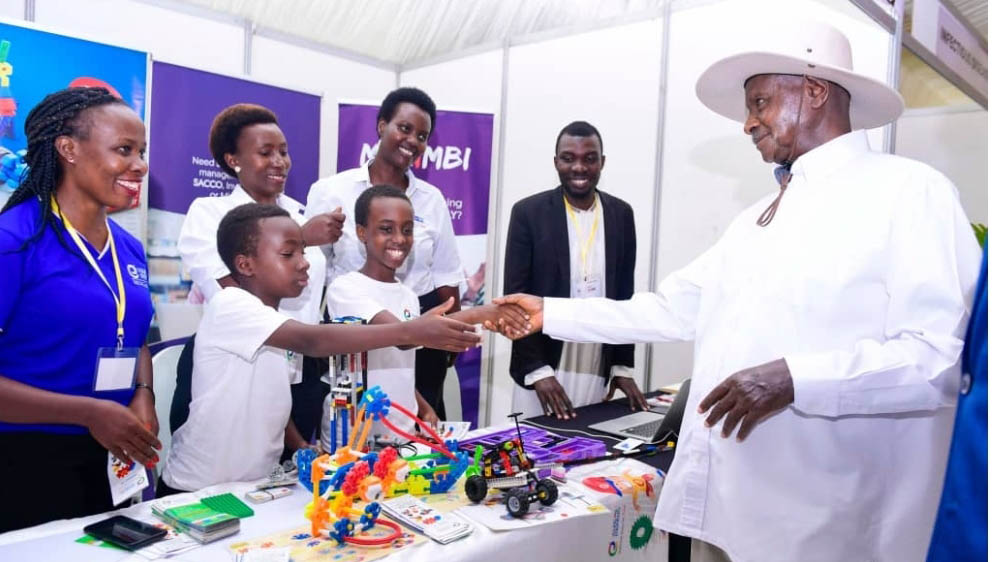
Young people demonstrating science, technology
and innovation.
Watch the President
Recent messages on education, technology and skilling
Education • AI • Science
International Day of Education 2025
President Museveni discusses education, science,
technology and Artificial Intelligence.
Skills • Employment
Expanding practical skilling opportunities
Remarks on industrial skilling hubs, employable skills
and preparation for self-employment and job creation.
Skills • Production
Skills linked to productive livelihoods
A message connecting practical skilling with production,
enterprise and income generation.
Archive • Education
Original education message
The video that appeared in the original version
of this blog page has been retained.
The goal is an educated, skilled, innovative and productive generation
Education succeeds when young people can transform knowledge
into competence, competence into productivity and productivity
into better livelihoods for themselves, their families and
their communities. The task ahead is therefore to ensure that
access to education is matched by quality, practical skills,
technology, innovation, career awareness and pathways into
productive economic activity.
This is a good message from our president. He should go ahead to ensure that what is said is put in practice. The headteachers in most government secondary schools are the most unpatriotic, unfocused and do not understand the national goals for development. Their actions should be in line with vision 2040 but what i see on ground is totally different.
Great post i must say and thanks for the information. Education is definitely a sticky subject. However, is still among the leading topics of our time. I appreciate your post and look forward to more. kampala international university
This is a good message from our president. He should go ahead to ensure that what is said is put in practice. The headteachers in most government secondary schools are the most unpatriotic, unfocused and do not understand the national goals for development. Their actions should be in line with vision 2040 but what i see on ground is totally different.
ReplyDeleteGreat post i must say and thanks for the information. Education is definitely a sticky subject. However, is still among the leading topics of our time. I appreciate your post and look forward to more. kampala international university
ReplyDelete